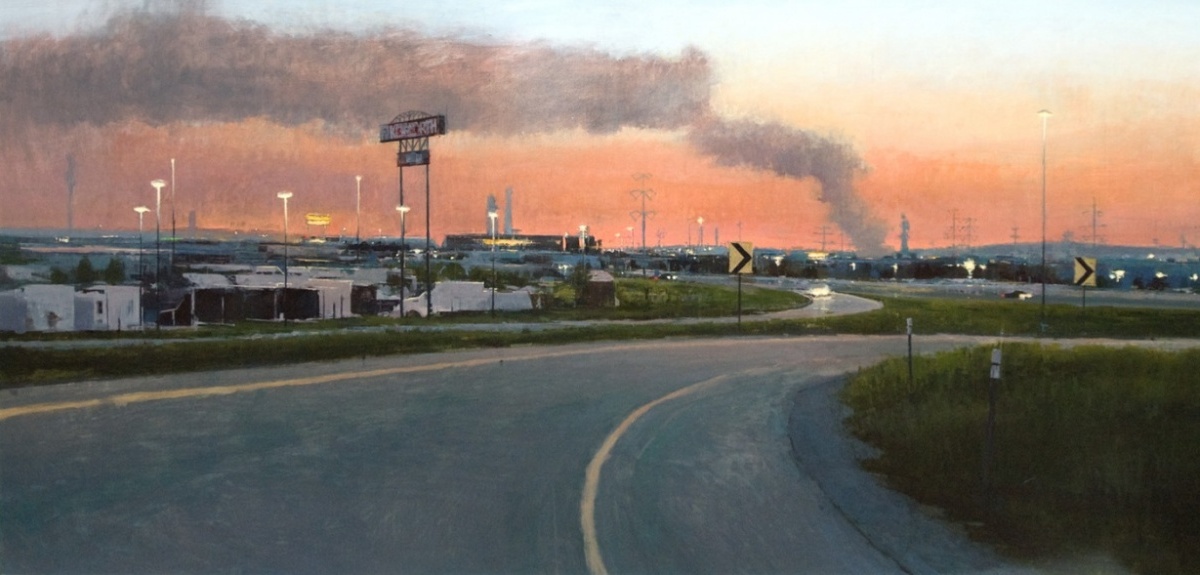
Exploring Color Harmony in Pastels


5 January - 1 February 2008

Colleen K. Howe was born in American Fork, Utah in 1953. Shortly thereafter, she moved to southwestern Montana with her family. Growing up on a 1,000 acre cattle ranch in the middle of the Big Hole Valley definitely encouraged her to love the open landscape. She had many adventures on her paint horse, Pinky, exploring the meadows and river places near her home. She attended a two-room school house in Jackson, Montana, and since her teacher was responsible for four grades, she took advantage of free time by drawing on a seemingly unending supply of manilla paper found on shelves in the back of the room.
 
Colleen continued her interest in landscape by studying painting at Brigham Young University and the University of Utah. She then specialized by studying pastel painting with Sally Strand. After that, it was many years of painting to gain experience and develop her style of clean and harmonious color.
 
Teaching has been one of Colleen’s interests. Her plein air painting workshops have been conducted across the United States, including California, Illinois, Missouri, Oregon, Montana, Washington and Utah. Another interest has been leadership in existing art groups or forming new artists’ organizations such as the Pastel Society of Utah.
 
Colleen’s work has received recognition in local and national competitions. In 2005, she was awarded prestigious signature member status with the Pastel Society of America and American Women Artists. She is one of the invited artists who participate in “Maynard Dixon Country and painting events with the Plein Air Painters of  Northern Utah and the Rocky Mountain Plein Air Painters. Articles about her work have appeared in The Pastel Journal, The Artist’s Magazine and Southwest Art. In 2007, her painting “Mt. Logan” won the Silver Award at the International Association of Pastel Societies Exhibition in Naples, Florida.
View her work at: www.colleenhowe.com.

She is currently represented by the following Galleries:
Apple Frame Gallery, Bountiful, Utah
Authentique, St. George, Utah
Bingham Gallery, Mt. Carmel, Utah
Fuhriman’s Fine Art, Logan, Utah
Montgomery Lee Fine Art, Park City, Utah
Westbrook Galleries, Carmel, California
Williams Fine Art, Salt Lake City, Utah
 
 
Colleen's Painting Process
 
"My time now is spent pretty evenly divided between painting outdoors and studio painting. Either way, I have found planning to be an important part of my process.
 
"Effective value is the structure of a good landscape painting. I will begin by sketching out the main idea and assigning values (light, medium or dark) to shapes in the painting. Most of the time I will need to simplify and leave out intermediate values to retain a structure or abstract idea.
 
"Next is to translate the value idea to color. This is where the color study comes in. This study is used both for choosing color in the correct value and for choosing colors in pastel that work well together.
 
"Remember: Value does all the work, Color gets all the credit.
 
"I stand back to check the studies to see if the idea carries from 10 feet or so. I can get a feel for how the color works together without recognizing any separate concrete forms (mountain, sky, land). I make any adjustments while in the study stage and try out different possibilities, then choose the best one. 
 
"Pastel can be pulled off with a chamois cloth, then new color applied. If I layer pastel, it is important to start a little darker, harder, and more saturated in color that I want to end up with. Color applied over another should look clean and pick up just a little of the color underneath. If it looks chalky or muddy, it is too big of a value change or is the wrong temperature.
 
"The important part of the study is to get the main idea in value and color. This study can be used as a finished piece or as a source of information for a larger work. Painting outdoors can allow you to see into the shadows, feel the atmosphere and accurately perceive color of light and color harmony."
 
 
What is Pastel?
 
Pastel does not refer to pale colors, as the word is commonly used in the fashion and cosmetic industries. Pastels are made with exactly the same pigment used to make all art paints. Powdered pigment, mixed with a little water and a special binder, is ground into a paste, rolled into sticks, and left to dry. The name comes from the French word pastiche, meaning paste. It is a painting medium with a full range of artistic possibilities. In the hands of a skillful painter with knowledge of pastel’s properties, a complete range of colors, values, and techniques is possible.

The history of pastel can be traced back to the 16th century, but it became popular in the 18th century. Although its invention is attributed to the German artist and chemist Johann Alexander Thiele, it was Rosalba Carriera who was its real pioneer. Carriera (1675-1758), a Venetian woman, painted beautiful, fully finished pastel portraits. In 1720, her renown took her to Paris, where she dazzled French royalty with this relatively new medium and started a pastel frenzy that lasted for decades.
 
During this time, hundreds of pastel artists worked in Paris, of which one of the most brilliant was Maurice Quentin de La Tour (1704-1788). Another artist, Jean-Baptiste-Simeon Chardin, took up pastel when failing eyesight prevented him from continuing his work with oils. He introduced new ways of building up color. These innovators were followed by famous artists such as Watteau, Delacroix, Millet, Manet, Renoir, Toulouse-Lautrec, Glackens, Whistler, Hassam, and Cassatt, who used pastel not just for sketches but for finished works.
 
In 1882, William Merritt Chase returned to New York City from Europe and formed the Society of Painters in Pastel. That society has since disbanded, but a new one took its place, the Pastel Society of America, organized in 1972. To gain signature status with this organization is prized recognition, and the artist is permitted to write PSA after his/her name.
 
The most famous pastel artist of all time is most likely Edgar Degas (1834-1917). With his death and the advent of cubist style, pastel use as a major medium died down and was primarily used by illustrators. Pastel has experience a new rise in popularity in the last ten years with improved sanded papers and wide selection of pastel manufacturers.
 
As a direct and immediate medium, pastel frees the artist from the restrictions imposed by the more complicated and elaborate medium of oils. Unlike oils, pastel requires no mixing on the palette, and no drying time is required. Fixative is not required on sanded papers, and these papers allow the crystalline nature of pastel to layer on top of each other rather than become “mud” on a flat, untextured paper.
 
Pastel colors will stay as fresh and vibrant as when they were first applied (no cracking, fading or yellowing). Pastel can be used for both drawing (line) and painting (mass and shape), and color variation can be mixed optically by layering color. Because of its layering possibilities, pastel is an excellent medium for studying color.


Care of Pastel Paintings
 
The term “pastel” can cover several different types of materials: soft pastels, oil pastels, and pastel pencil. We will be discussing soft pastel only for our purposes here.
 
Soft pastels come in different levels of hardness, so it is helpful to sample pastels from different manufacturers or talk to a knowledgeable pastel artist before purchasing materials.
 
Pastel is the most durable medium, but must be protected by glass so that the particles are not accidentally brushed off by fingers or clothing. Fixative is only used when necessary. Its true purpose is to “fix” the underlayer, or prepare one layer to receive more pastel over it. It is mainly used on smoother papers to re-establish a surface between layers of pastel. Fixative will flatten and darken colors when applied, so it is important to NOT use it on the last layer of the painting.
 
Sanded papers, particularly Wallis paper and Ersta paper, are made to hold many layers of pastel and not require fixative to hold the pastel on the paper. When framing, be sure that your framer understands how to handle pastels so that they will not be damaged by mishandling or touching the surface of the painting. To remove any extra pastel, hold the unframed painting upright or slightly forward and tap the back of the painting a few times. If you can frame keeping the surface UP, you will avoid particles falling onto the mat.
 
Paintings may be framed with a mat or without. Most artists use a spacer between the mat and the pastel, or if framing without a mat they will use a spacer between the glass and the pastel. AR, or anti-reflective glass is very helpful to cut glare dramatically. The French method is to place the glass directly on the pastel surface, tape the edges of the painting and glass completely (no gaps) and then place in the frame.
 
As with any painting, it is best to not hang it where it will receive direct sunlight. UV protecting glass is available with Museum or AR glass. Check with each artist to make sure they are using archival materials, regardless of media type. To transport pastels, either lean them back at an angle (separating paintings with cardboard) or lay flat.


Plein Air Painting
 
This is a French term meaning to paint outdoors. A painter will try to pack up his/her equipment as simply as possible and head out to paint. Some are fair- weather painters; some will go out every day, no matter what. Prior to the Impressionists, most painting was done in the studio, landscapes were “made up” to support other things (figures, houses, animals, etc).
 
Why go outdoors? It is like painting anything else: painting from life provides the model with the most truth to it, whether still life, figure or landscape. Photographs are a good tool to remember shapes, but color and perspective can be inaccurate in most photographs. Shadows can be too dark and skies or other light areas bleached out.
 
It is important to limit size according to what a painter can handle in a two-hour period. Light changes greatly in that amount of time, and the painter should stop or begin another piece. It is also important not to stand in a place with a great amount of reflection from the ground (light cement) and to keep the palette and painting in shade. This helps the artist to make better color/value judgments and to not be blinded by the reflection from the canvas or paper.
 
(the above text was supplied to the Museum by Colleen Howe.)


Contact Us
    Site Map     Rights and Reproductions     Springville City
 
Docents
Desk, Reserve and Special Events
Internship Program
Art Royalty
Junior Art Guild
Docents
Desk, Reserve and Special Events
Internship Program
Art Royalty
Junior Art Guild
What is SWAP?
SWAP Sponsors
SWAP Committee Members
Community & Family Night
Children's Art Festival
Workshops and Symposia
High School Show
Christmas Lamb